By Tina Saul, Founder, KINTAL
In April, Anthropic quietly shipped a tool that lets a cheap AI model call up a more expensive one, but only when it gets stuck. It's called the advisor tool. It took us three months to notice it, which is partly the point.
We care about this because model routing is no longer a technical footnote. For clients, it's the difference between an AI system that looks affordable in a demo and one that survives real usage. That's the lens we bring to any new release now: not "is it impressive" but "does it change what we tell a client to spend."
The stranger part is how little discussion followed. When we went looking for the wider conversation around the advisor tool, there wasn't much to find either.
How it works
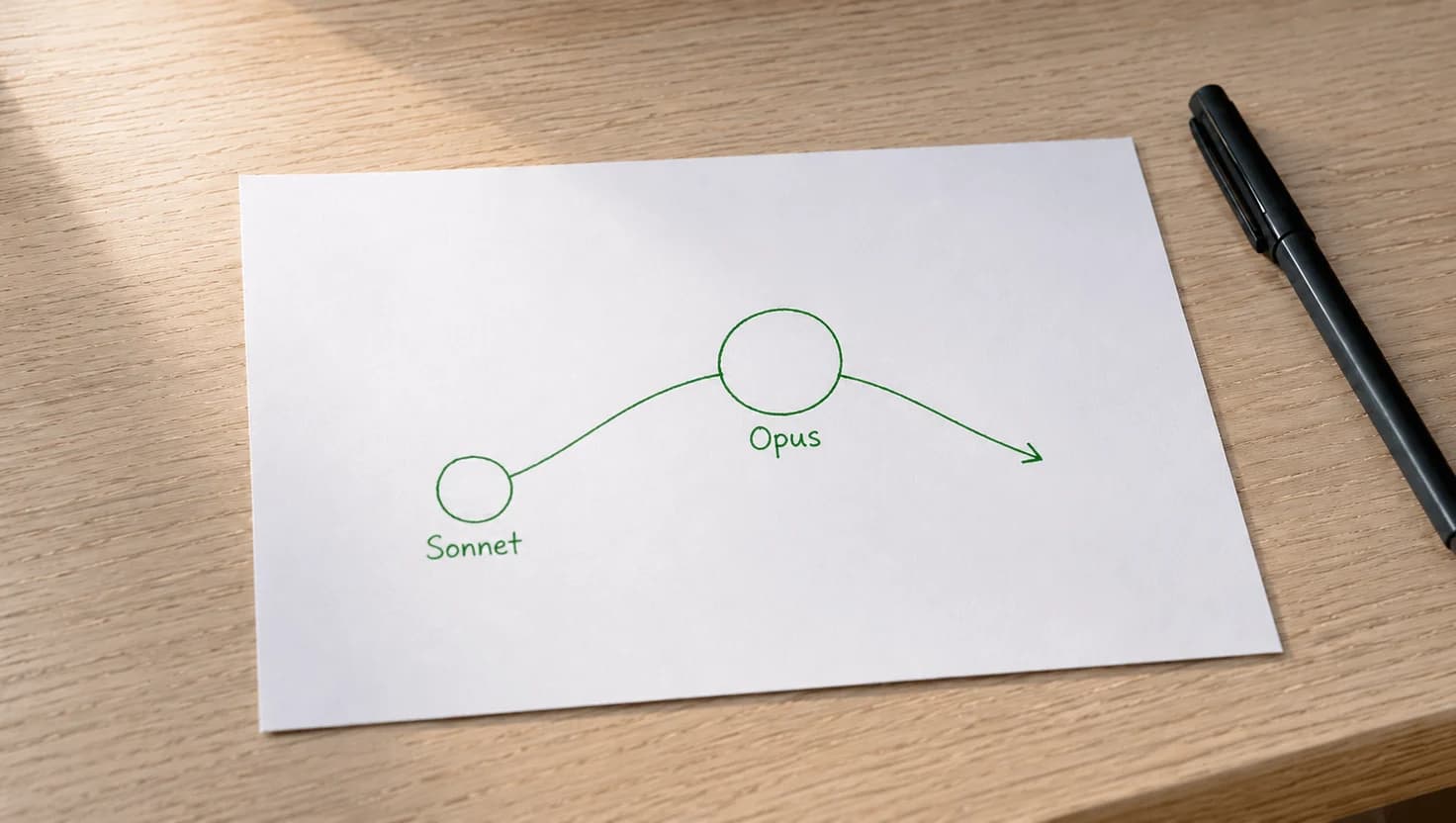
Instead of running every step of a task on your most powerful, and most expensive, model, a cheaper model does the driving. Sonnet or Haiku handles the ordinary decisions: reading results, calling tools, working through the routine branches of a task. When it hits a point it genuinely can't resolve on its own, it asks Opus for a plan or a correction, then carries on. Opus never touches a file or runs a command. It only advises.
It reverses the management instinct many non-technical teams bring to model choice: put the smartest, most expensive model on the job and assume that buys safety. Here, the cheap model stays in charge and only calls for help when it actually needs it.
Anthropic's own testing, which we'd treat as a starting point rather than proof, showed a Sonnet-plus-Opus pairing beating Sonnet alone by 2.7 points on a hard coding benchmark, while costing 11.9% less per task than running Sonnet on its own. The Haiku pairing was more striking in one direction and more honest in another: on a research benchmark it more than doubled Haiku's solo score, from 19.7% to 41.2%, at a fraction of the cost. But the same pairing still trailed Sonnet run on its own by 29 points on that benchmark, so the 85% saving against Sonnet buys a real drop in quality, not a free lunch. Worth testing against your own workload before taking any of it on faith, but the direction is credible.
Why this went unnoticed
It shipped behind a beta header and a feature flag, the developer equivalent of a soft launch. There was no keynote, because there didn't need to be one. It landed in the same quarter as several headline model releases, and an unglamorous cost optimisation for engineers doesn't compete with a new flagship for attention. The people actually using it are saving money on their agent bills, not writing LinkedIn posts about it.
We missed it too. Most of what reaches a business audience is the model layer: which one is smartest, which one launched this week. The cost decisions sit in routing, orchestration and tool use, one level down from the headlines. That is where agent costs are increasingly won or lost.
A pattern we already knew
This isn't a new lesson for us. Earlier this year, one of our retained clients came to us ready to commission a large, engineering-led rebuild. We made the case for scaling it back: a modular approach with the team leading the design, rather than handing the whole thing to a build team before anyone had proven they needed one. The fix wasn't more engineering. It was a smaller, right-sized approach that matched what they were actually ready for.
It's the same instinct behind the advisor tool: don't reach for the expensive option before you've proven you need it.
We run that check on our own tooling too, because it catches expensive defaults before they become normal. Partway through drafting this piece, we caught ourselves running the most expensive Claude model for a task that didn't need it, and switched to the cheaper Sonnet 5 on medium effort instead. Smaller stakes than the client decision above, but the same habit.
The bit that isn't settled yet
Then the picture moved again. On 30 June, Anthropic released Sonnet 5 as its new mid-tier model, priced well below its flagship Opus 4.8 and built for agentic work. It arrived just as Fable 5, Anthropic's most capable public model, came back from a suspension of its own, and that changes who the advisor tends to be.
The suspension is worth getting right, because the short version doing the rounds gets the cause backwards. Fable 5 launched on 9 June. Three days later, on 12 June, a US government export-control directive forced Anthropic to cut access for any foreign national, which in practice meant pulling the model for everyone. It wasn't Anthropic taking its own model down over a safety worry. The stated trigger was a narrow jailbreak that a researcher had flagged, letting the model read code and point out exploitable flaws, but Anthropic publicly disagreed that so narrow a finding justified recalling a model used by hundreds of millions of people. Access returned on 1 July, once the controls were lifted and a new safety classifier was in place. The capability curve and the regulatory reaction sit in real tension, and any account that skips past that is telling you less than it should.
What matters for the advisor pattern is that Fable 5, not Opus, is now the advisor a lot of people are pairing with Sonnet 5. Early developer testing shared online, not an Anthropic benchmark, puts Sonnet 5 as executor with Fable 5 as advisor at roughly 92% of Fable's solo score on a hard coding benchmark, for around 63% of the cost of running Fable throughout. Treat that as a useful signal rather than a settled result, on the same terms as every other figure here.
But it does partly answer the question we were asking three weeks ago. If a cheap executor with an expensive advisor gets most of the way to the expensive model's performance at a fraction of the cost, that's a real argument for keeping the advisor pattern even as the flagship itself improves. A stronger mid-tier model handles the everyday work; the advisor earns its cost on the moments a task genuinely needs more. We still don't have a fully settled answer on when to reach for the pattern versus a stronger model alone, but three weeks ago we had none at all. That's the honest state of most AI cost decisions right now, and it's worth checking again in another three weeks rather than assuming this is where it lands.